If you’ve spent years leading complex systems and dynamic teams of high performers through moments of intense pressure and stress, you already know that strategy and intelligence aren’t the limiting factors: energy, timing and human factors are. Leadership ultimately lives in the collective nervous system, not the org chart; “triggering” events are where you either lose or gain perspective and engagement. The most effective leaders learn to metabolize stress rather than export it to their teams. Drawing on neuroscience, lived experience, and systems coaching, we offer a practical theory and a usable tool for anyone considering the shift from being the one with answers to being the one who stabilizes the field so better answers can emerge. Keep reading if you’re curious about becoming more effective as the head coach of your team and sense that leadership is less about control and more about emotional co-regulation in your relationships. This post is a special edition so it is a bit more epic than usual. Here are the two questions we are grappling wth in the post:
What does it mean to "get triggered"?
How do we make the best of a triggering event?
Game on!
•••
Near the end of my time in elementary school, I had a run-in with the school bully. Most Mondays, he would pick some hapless victim to beat up in front of the rest of the school on Friday afternoon. When I got tapped, I made it clear that I was not participating in this weekly ritual, but I showed up anyway to preserve my honour. I declared my refusal to fight, he punched me in the face twice and I walked away in apparent shame, unaware of the crucial life lesson I'd just learned...
•••
One of the artifacts of the DEI (diversity-equity-inclusion) movement in the last decade was the appearance of "trigger warnings" in movies, television shows and other media. (I saw one ahead of the movie "Love Actually" two years ago, but it has since been removed.)
I understand that trigger warnings and other ideas like "microagressions" and articles on "how to spot and avoid narcissists" are well-meaning attempts to establish and enhance psychological safety. I respect the intent of initiative. My elementary school yard was certainly not safe. Psychological safety is indeed an important precursor to personal and professional growth in a social context but it's not the only key ingredient...
In the conventional and more intuitive understanding of how emotions work:
- something happens (someone says or does something)
- that "thing" triggers an emotion of some sort (positive or negative, strong or weak)
- the emotion drives the corresponding behaviour (constructive or less constructive)
- something good or bad happens as result.
"You said something mean and made me mad. I naturally (and justifiably) reacted by punching you in the face. And you act all surprised by this? What else did you expect would happen?" This cause and effect model of emotion is logical and self-evident. It's just not how it really works.
What did I learn from getting punched in the face?
First, as Mikey says: "everyone has a plan until they get punched in the face". The world is a complex and fundamentally unpredictable place. I did nothing to cause the violence. Just being in the world is enough sometimes.
Second–and this is the key piece–I was a different person before the event and after the event. Evidently, I was more bulliable prior to the bully picking me as his weekly "sparring partner".
I am neither excusing the violence of the bully nor blaming myself as the victim. I am making a subtler–if potentially controversial– point about personal ownership. Somehow, and mostly by accident, I chose to stand-up to the bully and left the altercation less bulliable. I've suffered no bullies since (save one incident from a design client who ended up in prison from bullying someone else). I learned how to confront power by taking ownership of my own power and this has served me well as a coach of CEOs and entrepreneurs. It has taken me this long to figure out how to activate that power: I did not walk away from that fight alone...
•••
What is the purpose of your brain?
If you're like most people, you'd likely say some version of, "to think".
Lisa Feldman Barrett is currently the most cited neuroscience researcher and an expert in "How Emotions are Made". Her answer from "Seven and a Half Lessons About the Brain", is the concept of "body budgeting".
The core function of your brain is regulating your energy and anticipating the changes in the environment and inside your body that might affect your survival. Without energy we die. Sustaining my energy is my prime directive. Emotion, perception, cognition and action are all derivatives of the basic transactional demands of my physiological metabolism. I can reduce everything that I want (or don't want) to fulfilling these demands. But it's impossible to do this alone.
The core function of a relationship is co-regulation of collective energy. All parties in a relationship form an emotional co-regulatory system.
Without other people, life wouldn't just be less interesting; it would cease to exist. From the time I was conceived, I've been inseverably bound to other people not just for my identity but for my very survival. What began as an umbilical cord in the simplest of my relationships (with my mother) has expanded into a complex relational ecosystem of family members, friends, associates and partners–a kind of exoskeletal metabolism.
We are all working together to get our needs met in some fashion. When I approach my relationships more consciously, I tend to get my emotional and physiological needs met in the service of you getting your needs met. As good will builds in our relationship you will likely respond in kind. Our system spirals upward. The synergy that exists in a relationship system is what sustains the energy of the system. But this does not always happen. Society and the economy have their ups and downs. My business has its ups and downs. Like you, I have my good days and I have my bad days. Sometimes someone metaphorically punches me in the face.
As members of a relationship system in constant flux, we don't always operate at our highest and best. Sometimes the world seems like it's against us or we feel sick, tired, overworked or stressed. As our energy drains from the system, we let our more primal survival instincts hijack our collective sense of higher purpose. In this depleted state, we tend to drift unconsciously into getting our needs met at the expense of each other. Synergy collapses. A constructive process of growth and expansion devolves into a bald transactional process of self-protection and competition for scarce resources. Our system spirals downward. It's a zero-sum game. How do we reverse the spiral?
•••
I'm generally content until I want something I don't have or have something I don't want.
In the later part of 2011, I followed my mountain guide Patrick Delaney up an ascent of a frozen waterfall in Jasper National Park called Polar Circus. I had just turned 47 and had 29 seasons of ice under my belt. I attempted it several times as a younger climber and failed every time. It was the one that got away.
Polar Circus is long, difficult and risky and requires massive power and finesse to finish clean and safe. An expert climbing party of two typically completes the route in twelve hours car-to-car. We did it in seven hours. For Patrick it was a lifetime achievement as a guide and for me a lifetime achievement as an ice climber. At last we were content.
None of us achieves anything worthwhile without some sort of help. I wanted to get to the top of Polar Circus and I needed a strong guide to do it. Patrick wanted to guide Polar Circus and he needed a strong client to do it. We got there together as a partnership not as a group of individuals. In any given moment, a relationship is content or striving towards something that wants to happen. In my relationship with Patrick, Polar Circus wanted to happen.
Marita Fridjohn and Faith Fuller are the designers of a relationship and systems coaching program I took shortly after I completed Polar Circus. Core among their ideas is "the third entity". I did not climb Polar Circus alone and on that day; Patrick did not climb Polar Circus alone either (though he is still very capable of solo climbing it). It was the relationship system of Patrick and Keith who climbed Polar Circus. There is Patrick and there is Keith and there is our third entity Patrick and Keith. It was our synergy that enabled the achievement, not just our individual strengths and skills as guide and guest. A dynamic duo won the day.
•••
The moment you become aware of something that you want and don't have (or have but don't want) you need some sort of support from some person or group to achieve it. The fundamental relationship is between a leader and supporter. In a business relationship, the roles of leader and supporter oscillate from moment to moment and do not necessarily depend on a designation based on a formal power structure and hierarchy.
Triggering events can happen to me or they can happen for us.
Imagine the relationship of an archetypical CEO and the four members of her senior team. Her board hired her "to get what we want but do not have". She accepted the mandate. Different CEOs might have different reasons to follow the lead of a board, but she has now made it something that she wants but does not have. She is now all in and needs her senior team to follow her in the achievement of the very challenging objective.
The CEO has a leadership role with the four senior members of her support team. From a third entity perspective, there is the CEO and there is the senior team and there is the CEO and the senior team. There obviously needs to be a high degree of synergy in the relationship between the CEO and her senior team, if she is to efficiently and safely achieve their mandate.
When we go down a level, we consider the synergy potential within the senior team. How many separate relationships are there in a four-person support team? For starters, there are six 1:1 relationships. There is, for example, a COO (chief operations officer) and CFO (chief financial officer) who form a relationship system called the COO-CFO relationship. If this relationship system generates synergy and works well, it is easier for both the CFO-CTO (chief technology officer) relationship to work well and the COO-CTO relationship to work well, setting the tone for the CTO and CMO (chief marketing officer) to work well, etc.
The two people in each of the six 1:1 relationships have an emotional and physiological co-regulation dynamic. The relationship subsystem is either generating synergy and is in an upward spiral or it is devolving into a downward spiral. The affect cascades in either case. Synergy is the product of a healthy leader-supporter dynamic where each party operates with the understanding that "the best way to get my needs met is to help you get your needs met". At the transactional level there is a mutual flow of energy and at the relational level a mutual flow of support.
If all of the subsystems are spinning in one direction, the rotational mementum of the whole system spins in the same direction and with increasing momentum.
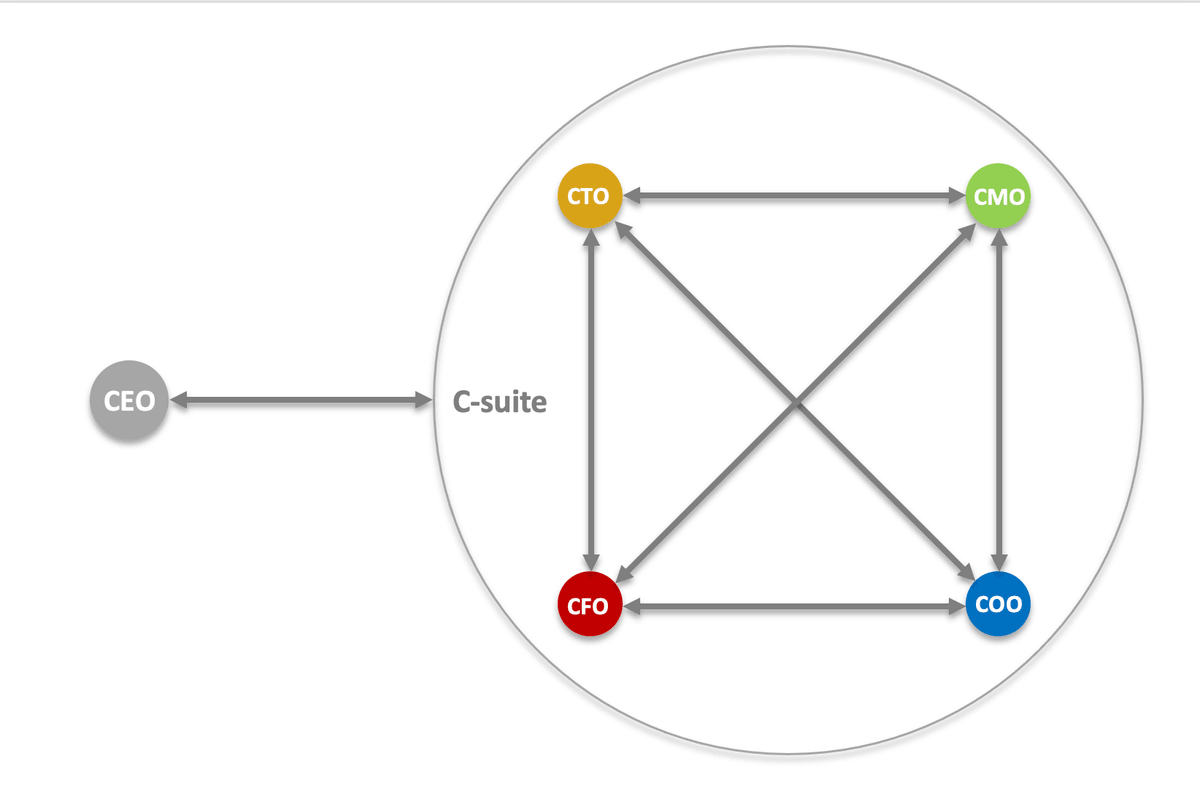
What makes this even more complex is the one 4-person subsystem, the four 3-person subsystems and the coalitions of four 3:1 and three 2:2 subsystems. This is total of 18 different relational dynamics; 18 opportunities for greater synergy or greater misalignment. The geometry goes up exponentially with the addition of each additional person, making for a very large coaching challenge for the CEO. But that is not even the most awesome part of it...
•••
A four-person team as I have described above has 18 different relational dynamics or links. This system at any given moment is creating more energy than it consumes or consuming more energy than it generates. If there is an energetic surplus–synergy to share–the system has energy to invest in other relationship subsystems. And where does that cascade begin?
There are not only 18 relationship subsystems in a four-person relationship system. There are an additional four if we account for the relationship each leader has with themselves.
My relationship with myself is the relationship I have between the person I've been and the person I am becoming. I am the synergy that exists between my past and future selves. If I learn to change my spin from negative to positive and increase my intensity, I can influence the rotational momentum of the system as a whole. If my positive spin is greater than the negative spin of my partner, the net spin of our third entity will be positive, as long as I can maintain my spin long enough to help my partner change their direction.
This is the fundamental choice in every moment: in the face of a triggering event, am I inclined to remain attached to the version of myself I've been (bulliable) or take ownership of the person I am becoming (unbulliable)? This is hard work. But if I have enough support it is much easier to take ownership of the opportunity instead of being a victim of the threat.
•••
And now theory becomes practice...
I met a Yoda-like golf pro named Grant with a very unusual Cancer story. When he received his diagnosis, he understood that his family would have a hard time with the news. That disease results in untold pain and suffering in the world, and its discovery to much fear and anxiety. That's understandable. But Grant made the counterintuitive decision. He chose consciously to have fun with his cancer. An odd choice. And it was not long after that that he was in full remission. (A positive mindset is obviously not sufficient by itelf to heal up from a deadly disease, but sometimes it can be the difference between life and death.)
Lives, businesses, families and teams are made up of an endless series of accumulating perception-action loops. This is the basic engine of growth, maintenance and decay in the relationship system. Each of my loops begins when I perceive an event (something I see, hear or feel physically) and then do or say something either constructive or less constructive. Grant's cancer loop appeared to begin when he perceived a triggering event: he saw an X-Ray and heard a cancer diagnosis from his doctor.
In the conventional cause-effect model of emotion, the diagnosis would somewhat automatically trigger fear, anxiety and self-protective behaviour, but in Grant that did not happen. He felt differently about his cancer and behaved differently with it. This is perhaps a very unusual response but obviously not an impossible one. He framed it as an opportunity more than he did a threat. The loop ends with an emotional pay-off (courage) and some material result (the situation improves or worsens) that prime the next loop.
Grant made what I would call a "bold" choice but he could also have easily made a more self-protective "timid" choice or "impulsive" choice, which would have been understandable. I think that he would say that being part of a family system that was constructed the way it was made it more likely that he would respond to his cancer diagnosis in a bold way. There was enormous goodwill and love in the family system in which he saw himself as the leader. There was no guarantee that the bold choice would lead to success and it was not a given that he would always make the bold choice but he was primed to do so. The feeling was not a result of the choice or the event itself. The emotion was already there in the system, in his physiology but also in the family. When Grant behaved in a way that was bold, it was much easier for his family to respond in a way that was also bold. Cancer does not just happen to a person. It happens to a relationship. And it is not just healed by a lone person. It heals as a system if it's going to at all. If Grant had reacted to his diagnosis by being timid or impulsive, he would have drained the family of much needed energy and everyone would have more likely responded in kind.
Being bold has a positive cascade effect through a relationship system, building the energy required for a team to surmount a potentially threatening challenge. Being timid or impulsive will likely have had the opposite effect.
When one member of a system receives constructive help from another part of the system, their perception-action loops run in synergy with each other. The physical and emotional outcome from one loop becomes the trigger for another. Positive loops beget more positive loops and negative loops beget more negetive ones until they interact with a much stronger one.
•••
The tone I set determines how I experience the triggering event...

In my story about the bully, and in Grant’s story about his cancer, those triggers were essentially distractions (events that could pull focus from what's most important). Grant made a bold rather than timid choice about his cancer. The courage already present in his family system made that choice more possible and more likley. He made enough bold choices, with enough bold support, that good luck eventually shone upon him. Each loop in his cancer journey ended with more courage than it began, fueled by courage shared among family members. It doesn’t matter who puts it there. If the trigger appeared to him in his more stressed position, he might have felt a stronger pull to his fear and anxiety and he might have been more likely to make a string of increasingly timid choices.

In a complex team system, let's say my CEO has to deal with a four-person senior team that has drifted towards a more constrictive defiant and dismissive stress position, rather than its more expansive kind and playful mode. The system is turning against her and it's probably also performing less well as a result.
What's her counterintuitive and unconventional move? To deal with members of the team who are stuck spinning in negative loops, she will need to deal with that part of her own leadership that is still sometimes timid. She will have to deal with her stress positions, increase the size of her positive spin and be even bolder so the rotation of the senior team changes it's spin to the positive. The kind people then become kinder. The playful people more playful and the others less dismissive and defiant. The system improves and moves upward with each decision and rotation.
•••
Shit happens. It’s in the nature of shit to happen. The weather changes. Faces attract punches. It’s not always someone’s fault. We’re human. We have lots of messy emotions and lots of errant behaviours. But we also have choices (even when the choosing isn’t fully conscious). And it is rare that we are truly alone.
I inadvertently made a bold choice to confront my bully. I wasn't in a stressed position. I had the support of a good friend, and that mattered. Now I coach very powerful CEOs and entrepreneurs. After hitting a conscientious objector in the face twice, maybe my bully thought twice before impulsively picking the next kid the following Monday. Maybe he found the courage to do something better. Maybe we all can...
A different kind of New Year's resolution...
- What do you want this year that you don’t have (or have but don’t want)?
This is your primary objective for the year. - What’s most likely to get in the way of that?
This is your primary obstacle. - Which trigger on the chart above will you likely derail you (if you let it)?
This is your key triggering risk. - Who do you most need support or buy-in from?
This person or group is your key stakeholder.